
































Healthcare foodservice teams have become increasingly familiar with the International Dysphagia Diet Standardisation Initiative (IDDSI) Framework. Yet one commonly overlooked challenge remains: mixed consistency foods.
Mixed consistency foods contain both liquid and solid components within the same bite, making them more challenging for some individuals with dysphagia.
Foods such as soup with noodles, cereal with milk, and watermelon contain both liquid and solid components that behave differently during chewing and swallowing. While these foods may appear soft and easy to eat, they can create additional challenges for individuals with dysphagia.
The good news is that addressing mixed consistencies does not require sacrificing flavor or enjoyment. With the right preparation methods, foodservice teams can create texture-modified foods that meet prescribed IDDSI levels while maintaining an appealing dining experience.
The following five-step approach provides a practical framework: Understand, Identify, Assess, Modify, and Verify.
1. UNDERSTAND: What is Dysphagia, the IDDSI Framework and Mixed Consistency Foods?
Dysphagia is the medical term for difficulty swallowing. People with dysphagia may have difficulty chewing food, controlling food and liquids in the mouth, or moving food and beverages from the mouth to the stomach. Because swallowing difficulties can increase the risk of choking, aspiration, malnutrition, and dehydration, texture-modified diets are often prescribed to support safer eating and drinking.
The IDDSI Framework provides a standardized system for texture-modified foods and thickened liquids. Healthcare organizations use IDDSI terminology and testing methods to improve consistency and communication among foodservice staff, dietitians, speech-language pathologists, nursing staff, and caregivers.
Many foodservice professionals are comfortable identifying IDDSI levels and applying associated testing methods. Understanding mixed consistencies adds another important layer to successful IDDSI implementation.
What Makes Mixed Consistency Foods Challenging?
Mixed consistency foods present unique swallowing challenges because liquid and solid components behave differently during eating.
The liquid portion may flow quickly toward the pharynx (throat), while solid components require chewing and oral control before swallowing. Coordinating these different textures can be difficult for some individuals with dysphagia.
Importantly, mixed consistency is not an IDDSI Level. Rather, it is a food characteristic that should be considered when evaluating whether a menu item is suitable for an individual’s prescribed diet.
2. IDENTIFY: Spot Mixed Consistencies on the Menu
Mixed consistencies are easy to overlook because many are familiar foods that appear soft, moist, and appealing.
Common examples include:
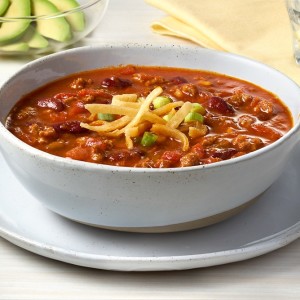
- Soup containing meat, vegetables, rice, or pasta in broth
- Cereal with milk
- Watermelon or other high-juice fruits
- Stews containing thin sauces and chunks of food
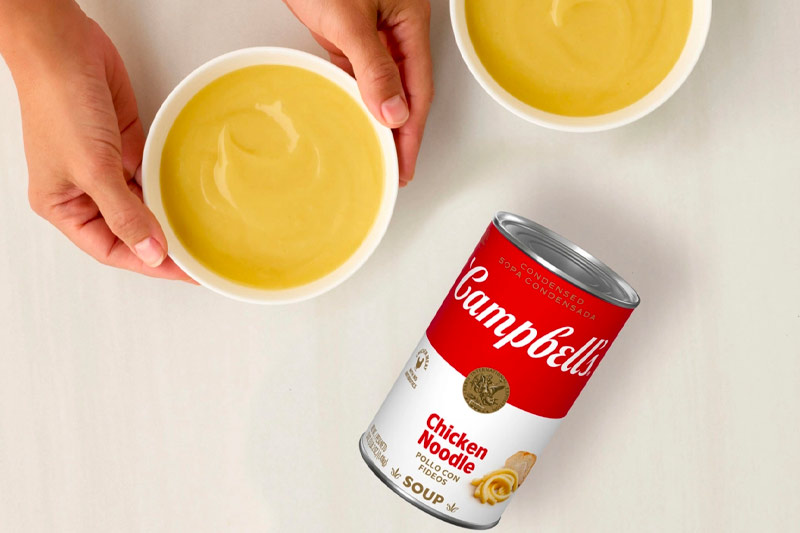
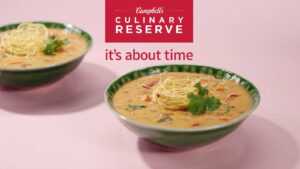
Soup is a particularly common example. Chicken noodle soup may contain broth along with noodles, vegetables, and meat. Even though the ingredients may be soft, the broth and solid components remain separate textures.
The same consideration applies to cereal and milk. The milk can separate from the cereal and move toward the throat before the cereal has been adequately chewed.
Juicy fruits such as watermelon present another example. During chewing, liquid can separate from the solid fruit and behave differently in the mouth.
The key point: a food does not have to look difficult to eat to be a mixed consistency.
That makes mixed consistency an important consideration throughout the foodservice process—from menu planning and recipe development to production and meal service.
It also creates an opportunity. Familiar foods can remain part of the dining experience when teams know how to prepare them appropriately. Flavor, aroma, appearance, and overall enjoyment still matter when serving people who require texture-modified diets.
3. ASSESS: Why Do Mixed Consistencies Matter?
Texture modification typically focuses on particle size, moisture, softness, and appropriate IDDSI testing methods. Mixed consistencies add another consideration: the person must coordinate multiple textures at the same time during eating and swallowing.
Consider chicken noodle soup. The broth may move rapidly toward the pharynx (throat) while the noodles, vegetables, and meat require mastication (chewing) and oral manipulation before they are ready to swallow.
For people with normal swallowing function, coordinating these differences is generally automatic. For people with dysphagia, managing the timing and control of multiple textures can be considerably more difficult.
Depending on their swallowing abilities, mixed consistency foods may require a person to:
- Control liquid movement within the mouth
- Chew solid components adequately
- Form a cohesive bolus
- Coordinate multiple textures at once
- Initiate a timely swallow while maintaining airway protection
When any of these abilities are impaired, swallowing difficulties may increase.
IDDSI Levels and Mixed Consistencies
According to IDDSI, mixed consistencies are typically not appropriate for people consuming:
- Pureed, Level 4
- Minced & Moist, Level 5
- Soft & Bite-Sized, Level 6
These levels require a uniform texture throughout the food. Items containing separate liquid and solid components do not meet these requirements and may increase aspiration risk.
People consuming Easy to Chew, Level 7 may be able to manage certain mixed consistency foods only when a clinician has evaluated the individual and determined that mixed consistencies are appropriate for their chewing and swallowing abilities.
Mixed consistencies are routinely appropriate only for Regular, Level 7.
Clinical recommendations must always be individualized based on swallowing evaluations and ongoing monitoring. Foodservice teams support good preparation by following the prescribed IDDSI level and ensuring menu items meet the required characteristics.
4. MODIFY: Create a Uniform Texture Without Losing the Appeal of Food
Once a foodservice team identifies a mixed consistency and determines that modification is needed, the goal is straightforward: create a uniform texture that meets the prescribed IDDSI level.
But texture is only part of the dining experience. Whenever possible, modification should preserve the food’s appealing flavor and overall eating experience.
Blending Mixed Consistency Foods
In some cases, such as stews with thin sauces or cold cereal with milk, the thin liquid can be drained, and the remaining food can be tested to determine the appropriate IDDSI level.
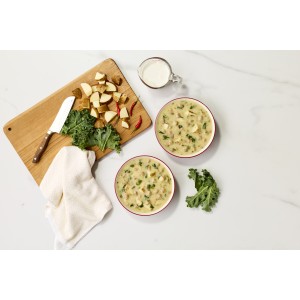
Other mixed consistency foods, including soups and juicy fruits such as watermelon, can be blended to eliminate separate textures and create a homogeneous product. Additional thickening may be needed to meet the intended IDDSI level.
The final product should have a consistent texture throughout, without visible separation between liquid and solid components.
All texture-modified foods should be evaluated using IDDSI testing guidelines. Standardized recipes, consistent preparation methods, appropriate equipment, and staff training support quality and reliability.
Most importantly, careful preparation can help foodservice teams deliver texture-modified meals that are not only appropriate for the prescribed diet, but also flavorful and satisfying.
Modifying Soups for Dysphagia Diets
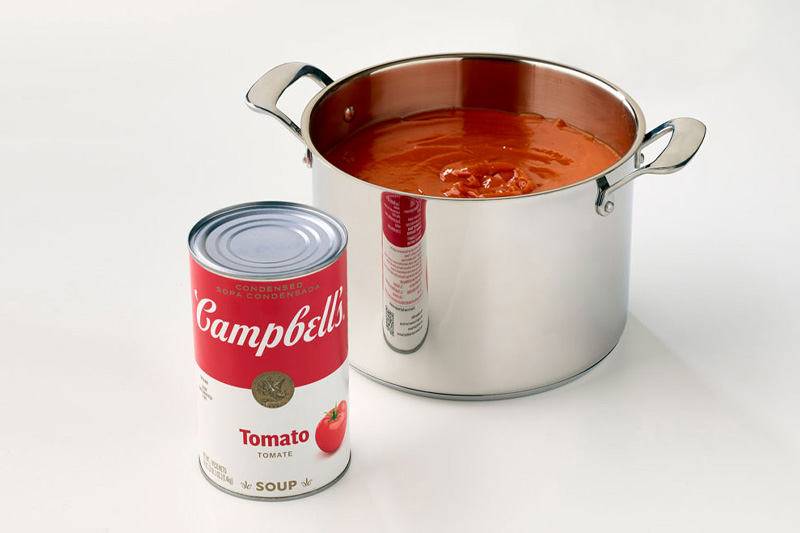
Soups require specific handling to meet prescribed IDDSI levels. To support consistent preparation across healthcare foodservice operations, Dietitian Margaret Roche, MS, RD, CSG, FAND of Roche Dietitians clinicians and Campbell’s Foodservice chefs to develop practical methods for modifying soups for dysphagia diets. Visit https://www.campbellsfoodservice.com/specialty-diets/.
“Our goal was to create clear, repeatable methods that help foodservice teams modify soup to a fully smooth texture and verify it at the correct IDDSI level,” Roche said.
While soups vary in ingredients and preparation needs, the workflow remains consistent:
Smooth or Strain → Heat → Thicken → Verify
This approach helps create a smooth, consistent texture while preserving the flavor and character that makes soup appealing.
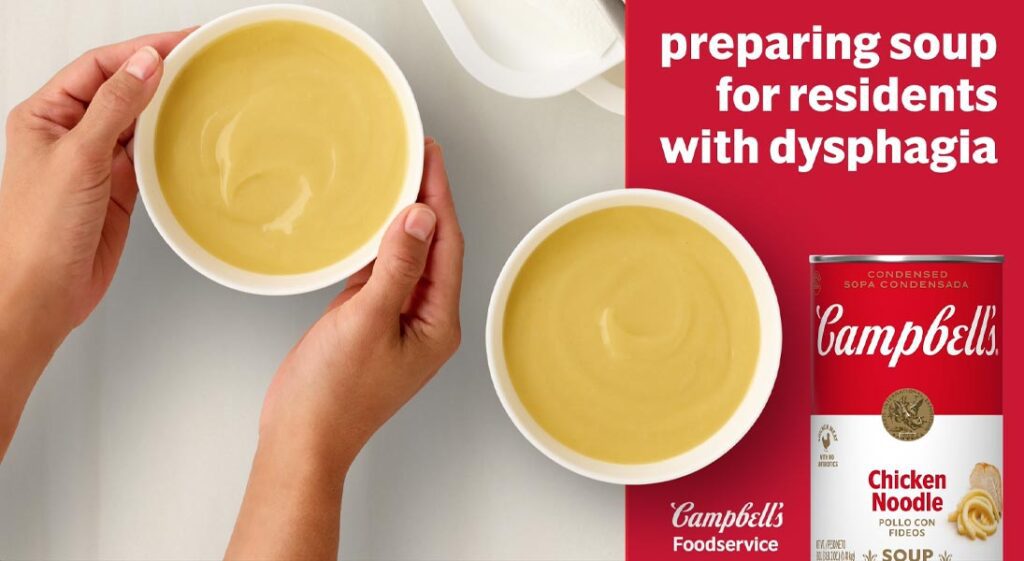
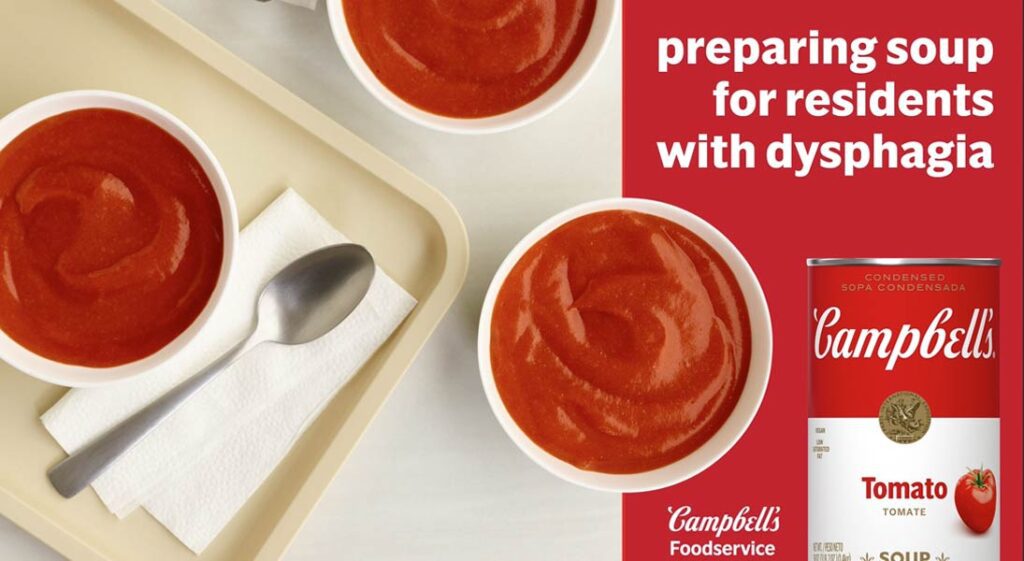
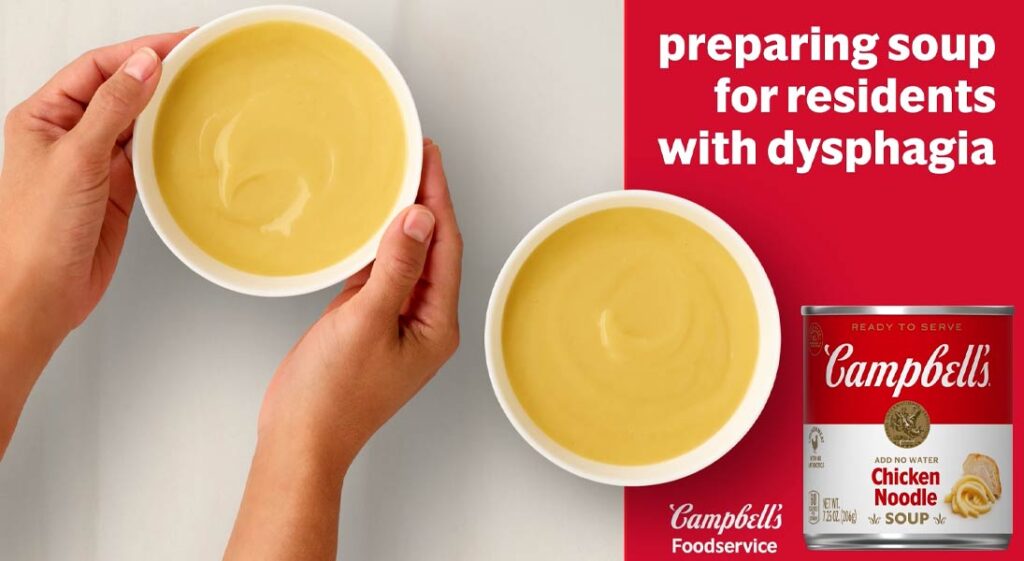
Smooth Soups
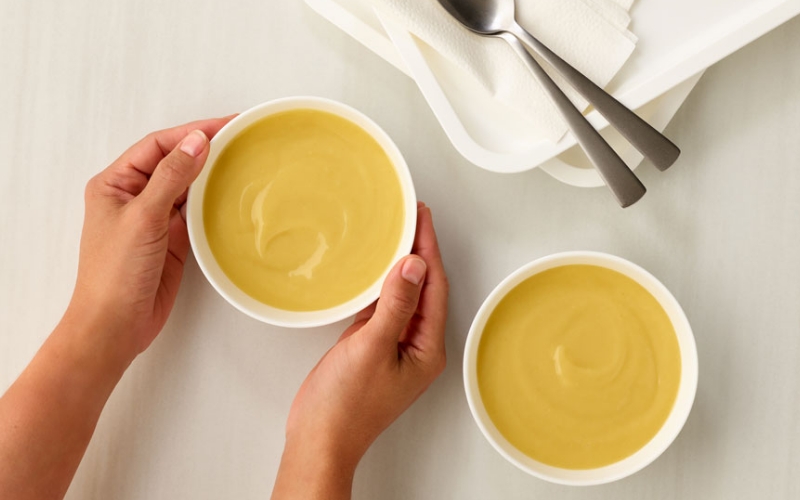
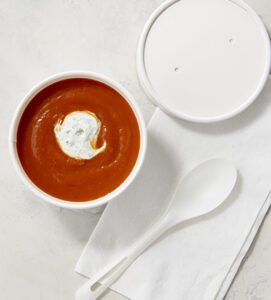
Smooth soups—such as tomato soup or cream of chicken soup without particles—require minimal modification.
After reconstitution and heating, they can be thickened to the prescribed level and verified using standard IDDSI testing methods.
Soups With Solids
Soups containing vegetables, noodles, rice, or meat require particle removal before thickening.
Solids are strained and blended until fully smooth, then reincorporated into the broth. Cream-based soups may need the solids blended separately to reduce foaming and support a uniform final texture.
Once smooth, the soup follows the same workflow:
Heat → Thicken → Verify
Single-Serve Soups
Single-serve soups follow the same principles. Smooth varieties can be thickened and heated directly. Single-serve soups containing solids are blended until smooth before thickening and heating.
In all cases, the final product should be fully smooth and verified at the prescribed IDDSI level.
5. VERIFY: Confirm the Final IDDSI Level
Modification is not the final step. Verification confirms that the preparation process actually produced the intended IDDSI level.
All modified soups must be tested using standard IDDSI methods before service. Temperature, thickener type, standing time, and equipment can influence the final consistency of a prepared food or beverage. Routine testing is therefore necessary to confirm that the intended IDDSI level has been achieved.
A food may look smooth or appear to have the right consistency, but visual inspection alone is not enough. Standardized IDDSI testing provides the final check.
Consistent recipes, established preparation procedures, appropriate testing methods, and staff training can help healthcare foodservice teams maintain consistency from preparation through service—while thoughtful culinary preparation helps ensure that texture-modified meals remain flavorful and enjoyable.
Putting Mixed Consistencies Into Practice
Mixed consistencies are a common feature of healthcare menus, but they require careful consideration when serving individuals with dysphagia. The five-step approach—Understand, Identify, Assess, Modify, and Verify—provides a practical, repeatable process for preparing foods that align with prescribed IDDSI levels while maintaining a positive dining experience.
To support implementation, detailed soup-modification guides developed by Roche Dietitians and Campbell’s Foodservice include preparation photos and thickener reference charts for healthcare foodservice teams.
MARGARET ROCHE [email protected]
Margaret Roche is the founder of Roche Dietitians.
References:
· American Speech-Language-Hearing Association. (n.d.). Adult Dysphagia. (Practice Portal). Retrieved June, 11, 2025, from www.asha.org/Practice-Portal/Clinical-Topics/Adult-Dysphagia/.
· Banda KJ, Chu H, Chen R. Prevalence of Oropharyngeal Dysphagia and Risk of Pneumonia, Malnutrition, and Mortality in Adults Aged 60 Years and Older: A Meta-Analysis. Gerontology. 2022;68(8):841-853. doi:10.1159/000520326
· Carbo AI, Brown M, Nakrour N. Fluoroscopic Swallowing Examination: Radiologic Findings and Analysis of Their Causes and Pathophysiologic Mechanisms. Radiographics : A Review Publication of the Radiological Society of North America, Inc. 2021;41(6):1733-1749. doi:10.1148/rg.2021210051.
· Chu Y-C, Chao JC-J. Effectiveness of diet modification on dietary nutrient intake, aspiration, and fluid intake for adults with dysphagia: a meta-analysis of randomized controlled trials. J Nutr Health Aging. 2025;29: 100486.
· Cichero JA, Lam P, Steele CM. Development of international terminology and definitions for texture-modified foods and thickened fluids used in dysphagia management: The IDDSI Framework. Dysphagia. 2017;32(2):293-314.
· Francesco M, Nicole P, Letizia S, et al.Mixed Consistencies in Dysphagic Patients: A Myth to Dispel. Dysphagia. 2022;37(1):116-124. doi:10.1007/s00455-021-10255-x.
· Hernández S, Verdú S, Talens P, Grau R. Development of Texture-Modified Meat and Thickened Soup Combination for Oral Dysphagia Patients With Uniform Firmness and Solid Appearance. Foods (Basel, Switzerland). 2025;14(14):2462. doi:10.3390/foods14142462.
· International Dysphagia Diet Standardisation Initiative. Complete IDDSI Framework and Testing Methods, version 2.0 (Detailed Definitions and Testing Methods V2, July 31, 2019) [PDF document]. International Dysphagia Diet Standardisation Initiative website. Published July 31, 2019. Accessed July 27, 2025. https://www.iddsi.org/images/Publications-Resources/DetailedDefnTestMethods/English/V2DetailedDefnEnglish31july2019.pdf
· International Dysphagia Diet Standardisation Initiative. (2025, January). Frequently asked questions: Exceptions—Bread and mixed consistencies. United States IDDSI Reference Group. https://www.iddsi.org/images/AroundTheWorld/UnitedStates/faq/USIRGFAQExceptionsBreadsMixedConsistencyJan2025.pdf
· International Dysphagia Diet Standardisation Initiative. (2020, September). Mixed and dual consistencies. https://www.iddsi.org/images/Publications-Resources/Publications/MixedDualConsistencies.pdf
· Reyes-Torres CA, Castillo-Martínez L, Ramos-Vázquez AG, et al. Effect of a texture-modified and controlled bolus volume diet on all-cause mortality in older persons with oropharyngeal dysphagia: Secondary analysis of a randomized controlled trial. Nutr Clin Pract. 2024;39(3):665-672. doi:10.1002/ncp.11052
· Thiyagalingam S, Kulinksi AE, Thorsteinsdotter B, et al. Dysphagia in Older Adults. Mayo Clin Proc. 2021;96(2):488-497.
· Wilkinson JM, Codipilly DC, Wilfahrt RP. Dysphagia: Evaluation and Collaborative Management. American Family Physician. 2021; 103(2):97-106.